The first Black Forest Cuckoo Clock was designed and made by Franz Anton Ketterer in the small village of Schönwald near Triberg, Germany, in the depths of the Black Forest. Ketterer managed to reproduce the cuckoo's call by the clever use of bellows producing two different sounds. Over the following years, the clock industry developed rapidly in the Black Forest. With their inventive genius, cleverness and dexterity, the inhabitants of the region employed the long winter months in making cuckoo clocks with richly hand carved decorations from various woods. In 1808 there were already 688 clockmakers and 582 clock peddlers in the districts of Triberg and Neustadt. During the long winter months, the farms were snowed-in and the people had a lot of time to create finely handcrafted cuckoo clocks of many styles with rich and varied carvings. The first clocks of the Black Forest, called “wood-beam clocks” were built around the year 1640, on a farm called Glashof. The clocks were made entirely of wood, including the movements. These original clocks evolved during the early 18th century into clocks known as the “Schilderuhr” which added hand painting, a minute hand, and chimes. All over the world the cuckoo clock is regarded a symbol of the Black Forest. Since the 18th century the clockmakers of their region have specialized in the development of this type of clock. The cuckoo clock became known throughout the world thanks to the peddling "clock carriers" from the Black Forest who literally carried the clocks on their backs in rucksacks. The first model of a cuckoo clock was a painted wooden clock. The clock was composed of an almost square board for the clock face and a raised semicircle, and was lavishly decorated. The cuckoo itself was to be found in the semicircle behind a small door. This type of clock was made from approximately 1730 on and was considered to be the specific clock style of the Black Forest. However, the exact origin of the cuckoo clock is not totally clear to this day. In the middle of the 19th century there were two principal visual forms of the cuckoo clock. The "framed clock", as its name suggests, had a strong wooden frame and a wide painted inner section to which the clock face was attached. The cuckoo was situated in the upper section of the decorated surface and was occasionally included in the other decorative scenes. The house-shaped basic form with wooden decorative elements was developed to include scenes from every day life. The earliest clock of this type had a wooden clock face with white numbers and hands and fir cone shaped weights. Today. vine leaves, animals and woodland plants as well as hunting scenes are features of this typical form of cuckoo clock. Dancing couples in traditional dress automatically move to music or the mill wheel rotates on the hour, while a farmer chops wood. The cuckoo itself moves its wings and beak and rocks back and forth when calling. Despite fluctuations in demand on the clock market, the production of the cuckoo clock in the Black Forest has remained uninterrupted to this day.
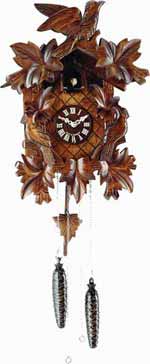
12", 1 Bird - 5 Leaf Carved German Cuckoo Clock
Authentic "Black Forest" Cuckoo made in Germany offers an authentic 8 day movement from one of the finest German cuckoo clock makers in the world. Eight Day Cuckoo Clocks are all mechanical and the two chains need to be pulled only once per week. The clock has a carved leaf pendulum and two massive weights to power the eight-day movement. A carved wooden cuckoo bird waits behind the door to "coo" the hour Large cuckoo case with 5 leaves and Bird. Antique stain, wooden dial and traditional numerals and hands. Hand carved leaves and pendulum made of Solid Linden. Heavy cast weights. Carved Wood Cuckoo bird Swinging Pendulum with door to open for the Cuckoo bird to appear and speak. Two year warranty.
Size: Height 12” Width 8” Depth 6”
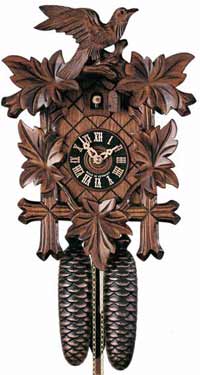
14", 1 Bird - 5 Leaf Carved German Cuckoo Clock This beautiful cuckoo clock is hand-carved in the Black Forest Germany.
Its quality mechanical movement counts the hour and plays once on the half hour.
Hones 14" tall 8 day, 5 leaf German Cuckoo Clock. Carved wood Cuckoo Bird.
Two Year Warranty and Free Shipping.
Size: 14" tall not including weights and pendulum.
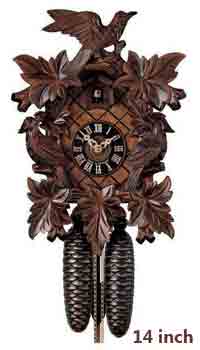
14", 3 Bird - 7 Leaf Carved German Cuckoo Clock
This beautiful cuckoo clock is hand-carved in the Black Forest Germany. Its quality mechanical movement counts the hour and plays once on the half hour. Hones Premium 14" tall 8 day, 7 leaf and 3 bird German Cuckoo Clock. Two Year Warranty and Free Shipping.
Size: 14" tall not including weights and pendulum.
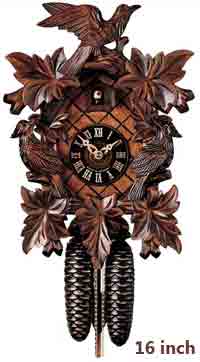
16", 3 Bird - 7 Leaf Carved German Cuckoo Clock
This beautiful cuckoo clock is hand-carved in the Black Forest Germany.
Its quality mechanical movement counts the hour and plays once on the half hour.
Hones Premium 16" tall 8 day, 7 leaf and 3 bird German Cuckoo Clock.
Two Year Warranty and Free Shipping.
Size: 16" tall not including weights and pendulum.
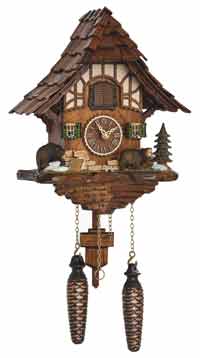
The Hermle Baiersdorf 54000 Quartz Cuckoo Clock is a hand-carved Chalet Style clock built in the Black Forest of Germany.
The clock is powered by a Quartz movement and never needs winding and keeps better time than a mechanical cuckoo clock.
These features include An Alpine style roof with wooden shingle and a Tudor design across the front.
One of the two Bears is examining a honey pot with a swinging wood pendulum below.
The clock plays 12 different melodies.
The quartz movement features volume control and light sensor for auto night off for the Cuckoo bird and the music. The Quartz Movement is powered by 3 "C" size Batteries.
Three Year Warranty and Free Shipping.
Size: Height 9.5″, Width 9.5″, Depth 6.5".
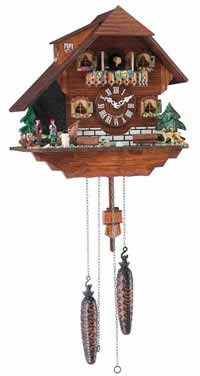
Quartz, battery operated chalet style Cuckoo Clock made in Germany. Four figures on a dance platform as they rotate while the cuckoo bird will call on the hour with sound of waterfall in the back ground. The case is trimmed with a trees, Deer, bench, water trough and wood pile. Features a volume control and auto night shut off when the light gets low in the evening. Three year warranty and Free Shipping.
Size: 18" Height x 12" Width (including pendulum) - 12" Tall x 12 wide not including the weights or Pendulum
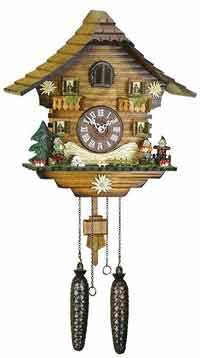
Hermle Neustadt Chalet Style Quartz Cuckoo Clock Made in Germany. Traditional Black Forest home and the Edelweiss flowers. The cuckoo bird will appear from behind the doors and count on the hour with sound of waterfall in the background. Quartz, battery operated movement Three year warranty and Free Shipping.
Size: Height 17-3/4 x Width 11-1/2" x Depth 6-1/4 (inches)
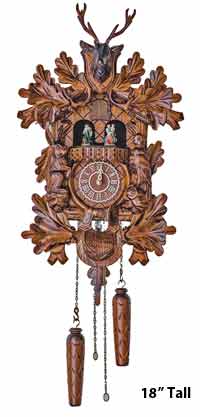
The Hermle Schwarzwald 61000 Quartz Cuckoo Clock is an oversized, traditional hand-carved clock built in the Black Forest of Germany.
The clock is powered by a Quartz movement and never needs winding and keeps better time than a mechanical cuckoo clock.
These features include intricately carved birds, ten oak leaves, the head of a deer with magnificent antlers and beautifully detailed and hand painted figures
of Bavarian dancers who perform their dance routine on the hour as the cuckoo calls. There is also a horn and saddle motif below the dial and a swinging Oak leaf pendulum.
The clock plays 12 different melodies.
The quartz movement features volume control and light sensor for auto night off for both the dancers and the music. The Quartz Movement is powered by 3 "C" size Batteries.
Three Year Warranty and Free Shipping.
Size: Height 18″, Width 12″, Depth 6″.
Authentic "Black Forest" Large Cuckoo Clock offers a no maintenance Quartz Movement. The Hermle 44000 Villingen Quartz Cuckoo Clock will Cuckoo the number of the hour with a digital recording complete with the echo of the mountains of the Black Forest. Larger 7 Leaf Authentic Black Forest Cuckoo made in Germany offers a no Maintenance Quartz Movement. Clock will Cuckoo on the hour with a digital recording complete with the echo of the mountains. Quartz, German made battery operated movement is powered by three "C" batteries.
Three year warranty and Free Shipping.
Size: 20" Tall , Actual house with crown is 16 1/4 HT". x 11 3/4 Wide x 6 1/4 max Deep.
Retail Price:: $507.00save 33%
Discount Price $338.00
The Cuckoo Bird
The Cuckoo Bird The Cuckoo can be found in Africa, Asia and Northern Europe. They are slim bodied and are about 13 inches in length. They have a blue-grey head, breast and upper parts, and horizontal barring on the under parts. However, the female also exists as a rare rufous (reddish) morph, so instead of being grey it is red-brown. They never build a nest, preferring instead to lay their eggs in the nests of other birds who unwittingly raise the cuckoo fledglings as their own.
We promise to
provide quality products and the best service possible. If you have a question about
any product we carry, please call us at 1-866-402-8714 M - F 10:00 - 6:00 EST., Sat 10:00 - 3:00
Security
Our Secure Site assures you of a secure transaction. Every page is secure, not just your checkout page.



 History of The Cuckoo Clock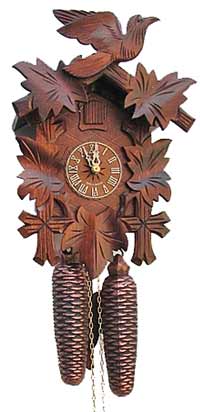
 Atomic Clocks
 We promise to
provide quality products and the best service possible. If you have a question about
any product we carry, please call us at 1-866-402-8714 M - F 10:00 - 6:00 EST., Sat 10:00 - 3:00
We promise to
provide quality products and the best service possible. If you have a question about
any product we carry, please call us at 1-866-402-8714 M - F 10:00 - 6:00 EST., Sat 10:00 - 3:00