
Grandfather Clocks: Setting The Time
Posted on October 15, 2010 | By clockde | 32 responses
How to set the time on your Grandfather Clock
Instructions for Howard Miller Grandfather Clocks made between 2000 – 2020.
Setting the time on your grandfather clock is quite easy. The following instructions work on major brands made in the last 30 years or so. This may not apply to older clocks.
Most grandfather clocks have a Westminster chime that plays a part of the Westminster melody on each quarter-hour, then plays the entire melody on the hour, then counts the hour.
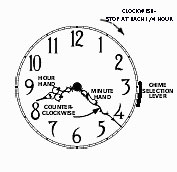
Setting the time on your grandfather clock. You may move the minute hand Counter-Clockwise without stopping or move it Clockwise stopping at each 1/4 hour and letting the chime play before advancing to the next quarter-hour.
To set the time, move ONLY THE MINUTE HAND counter Clockwise (backward) until the hour and minute hand are at the correct time. DO NOT MOVE THE HOUR HAND WHEN SETTING THE TIME. The hour hand will move automatically when the minute hand is moved.
By moving the minute hand counter Clockwise it is not necessary to wait for the Grandfather Clock to chime as the minute hand passes each quarter-hour. Most movements have a self-correcting feature that synchronizes the chimes with the time. If after setting the Grandfather Clock on time, it does not chime properly, permit it to operate for 2 hours to correct itself.
You may also move the minute hand clockwise, but you probably hear a “single-click” sound at each quarter-hour point. If you hear the click…stop and let the chime complete its sequence before advancing to the next quarter-hour. Continue a quarter-hour at a time until the proper time has been reached and allow the chimes to play at each quarter-hour.
CAUTION ON MOVEMENTS WITH AUTOMATIC CHIME SEQUENCING:
Automatic Chime Sequencing is a feature found on the most expensive clocks that will play one melody (ie: Westminster) on a given hour, the automatically change to the next melody (ie: Whittington) on the next hour. When it completes all of the melodies on that grandfather clock, it will start over again.
The chime selection lever should not be in the “Auto” position when moving the hands on a clock with Automatic Chime Sequencing. Moving the hands in either the clockwise or counterclockwise direction while the automatic chime sequencing is in operation could damage the chime mechanism.
When my grandfather chimes on the hour it is two hrs. behind. When it is 12:00 instead of 12 chimes it does 10 chimes. 10:00 it does 8 chimes. Is there a fix for this.
Thanks in advance for your help.
My clock is a Howard Miller
Thanks,
Iris
Hi Iris,
This usually happens when an hour hand is moved by mistake when re-setting the time on your grandfather clock. It is also easy for a finger to slip and move the hour hand while changing the time. Sometimes if a grandfather clock is allowed to wind down so the weights are on the bottom and the grandfather clock pendulum stops, this can happen.
The following page will show you how to make this easy correction on your clock.
Grandfather Clock Counts the Wrong Hour
Thank You,
Robert
My GF clock bongs the hours at the 1/4 hour past, example 3 PM it will bong at 3:15 PM. The bong count is right but the time is 3:15 PM. Thanks for the help.
Mel
Hi Mel,
This can be corrected with a simple adjustment. You may see the instructions at
My Grandfather Clock is a Quarter Hour Off from the chime.
It only takes a few minutes to complete this and is not difficult at all to correct.
Thanks!
Robert Pearson
Hi Paul,
I have a Sligh clock of faitlrly recent origin. When I last set it, I accidentally move the hour hand a bit forward, and now, when it chimes, it adds two extra chimes to the hour. Despite resetting it backwards, it has not reset properly. What can I do? Thank you
When my grandfather clock strikes 12 the minute hand is exactly on 12, but the hour hand is about a quarter inch off. This happens at every hour.
Can I manually move the hour hand forward that quarter inch so the minute and hour hand can be exactly on the hour markers?
Thanks!
Hi Lee, The hour hand is held onto the shaft of your grandfather clock by friction only. You may move it as needed to correct it’s position without disturbing any other function. Next time is starts to strike the hour, simply move the hour hand where it needs to be to correctly display the time.
Robert
Just acquired a grandfather clock,it works great, tried setting it for spring forward, didn’t know to go backwards to set,so went forward, I did stop at each quarter,
but didn’t let the chimes finish. Now it won’t chime. Will it eventually start back up?
Hi Paul…You should stop at each quarter hour when moving the hands clockwise or this can happen. If it doesn’t correct itself within a few hours, turn the minute hand counter-clockwise about 1 1/2 hours, then move it clockwise stopping at each quarter hour and letting teh chime complete before moving to the next quarter hour. This should work for you.
Robert
My gf clock has the day time back piece and night time back piece directed my behind the clock and it is showing day for night and night for day. How do I correct this ?
My clock is a half hour ahead. When it is 9:30 it strikes ten, etc. How do I fix it?
Hi Kayla,
The procedure for making this adjustment may be seen near the bottom of the following page:
If Your Clock Is Chiming Exactly 15 or 30 Minutes Off
Good Luck,
Robert
I did some more hunting on your website and found the exact information I was looking for. This site has been so helpful for a new clock owner and I am very grateful. Thanks so much!
Thank You Jody..I am glad the clock information was helpful.
Robert
My clock gains time. Approximately 5 minutes a day. What’s the tip to correct and make it keep accurate time?
Hi Dennis,
You can find the instructions on how to increase or decrease the speed of your clock at the link address below:
http://www.theclockdepot.com/clocks-blog/adjusting-the-pendulum-on-your-grandfather-clock/
Thank You!
Robert
Thank you Mr. Robert for your information. God bless you for your kindness and generosity in sharing knowledge.
I recently purchase a grandfather clock. As I was correcting the time, I accidentally went past a 15min mark without letting it chime. (I stopped each time to let it chime) Now the hands are locked and the clock has stopped. The pendulum isn’t swinging either. What should I do to fix this? Thanks.
Hi Lobi,
Try moving the minute hand backward about 2 hours. If the minute hands don’t want to move backwards…DO NOT FORCE IT. Then move the minute hand forward (clockwise) a quarter hour at a time and you should hear a “click” on each quarter hour. If the chimes start to play…let them complete and then go to the next quarter hour until you get to the correct time. Also, move your moon dial forward one day. It may be jammed and trying to stop the clock. This may work for you.
Good Luck,
Robert
We bought a used grandfather clock. The time runs good but how do we make the chimes go with the time. Right now the chimes are running 4 hours ahead of real time. Can you help explain what we must to do correct it?
Hi Jerry…The instructions you need are on the following page:
https://www.theclockdepot.com/clocks-blog/grandfather-clock-chimes-the-wrong-hour/
This will correct the hour count on your grandfather clock in just a few minutes. The clock count is right, but your hour hand is in the wrong position.
Thank You, Robert
Our clock keeps the time correctly but the chimes, chime 5 minutes past the time they should be chiming. The chimes chime at 5 after, 20 after, 35 after and 50 after the hour. How do we fix this?
Hi Bree, You need to follow the instructions on the following page:
https://www.theclockdepot.com/clocks-blog/grandfather-clock-does-not-chime-at-proper-time/
It is a trial and error procedure, but it will correct your issue.
Thank You,
Robert
My sister has asked me to correct the time on her clock which is only a couple of minutes. Is it just a matter of moving the minute hand when it is not on the quarter hour.
Thanks
Hi Bob…This is correct. You may move the hand forward or backward within any quarter hour. Robert
Hello,
My husband accidentally moved the hour hand clockwise while rewinding the clock. Can I move it counterclockwise to set it back at the right time?
Thank you for your help.
Hi Lucie,
You should be able to move the hour hand back counter-clockwise without issue if this is a clock made in the last 30 years. It may chime out of sync for the first hour of operation, but it will correct itself.
Good Luck,
Robert
Thank you for your efforts here. We appreciate it. My question is, should the chimes begin exactly at the 1/4 hour or slightly before? Does the sounding of the hour (bongs) start or finish on the hour or only count it after the chimes have finished?
Hi Bill,
Most feel the hour count should begin to play when the minute hand covers the entire minute marker at the 12:00 position. Most grandfather clocks have a provision for changing the minute hand position to the dial so it can achieve this. Most factory specs are that the clock chimes within 45 seconds either way of the top of the hour. The instructions for improving this can be found at:
https://www.theclockdepot.com/clocks-blog/grandfather-clock-does-not-chime-at-proper-time/
You can get the 12:00 position perfect and the quarter hours still may not be “dead on” depending on the grandfather clock movements design.
Thanks! Robert
Somehow when fixing the time on my clock last night I accidentally put the time into evening instead of daytime and now it’s not chiming during the day. How do I fix this? It’s an old trend GF clock that I got from my grandparents. Thank you very much!
Hi Tiffany,
Turn off the chimes with your chime lever and then set the time 12 hours ahead. Turn the chimes back on when the minute hand is pointing between the quarter hours. The clock may chime at weird times for the first hour or so and then the chimes will self-correct.
That should solve your issue.
Thanks!
Robert
Robert you have helped me in the past so here goes. My Howard Miller clock circa 2003 works perfectly except in the last week a strange chiming incident happened. At noon, and I assume midnight, it chimes around 25 times. Every other hour in perfect. What do you think is going on or how can I correct it?